eSick Leave in Serbia
The End of Paperwork, the Beginning of the Digital Era
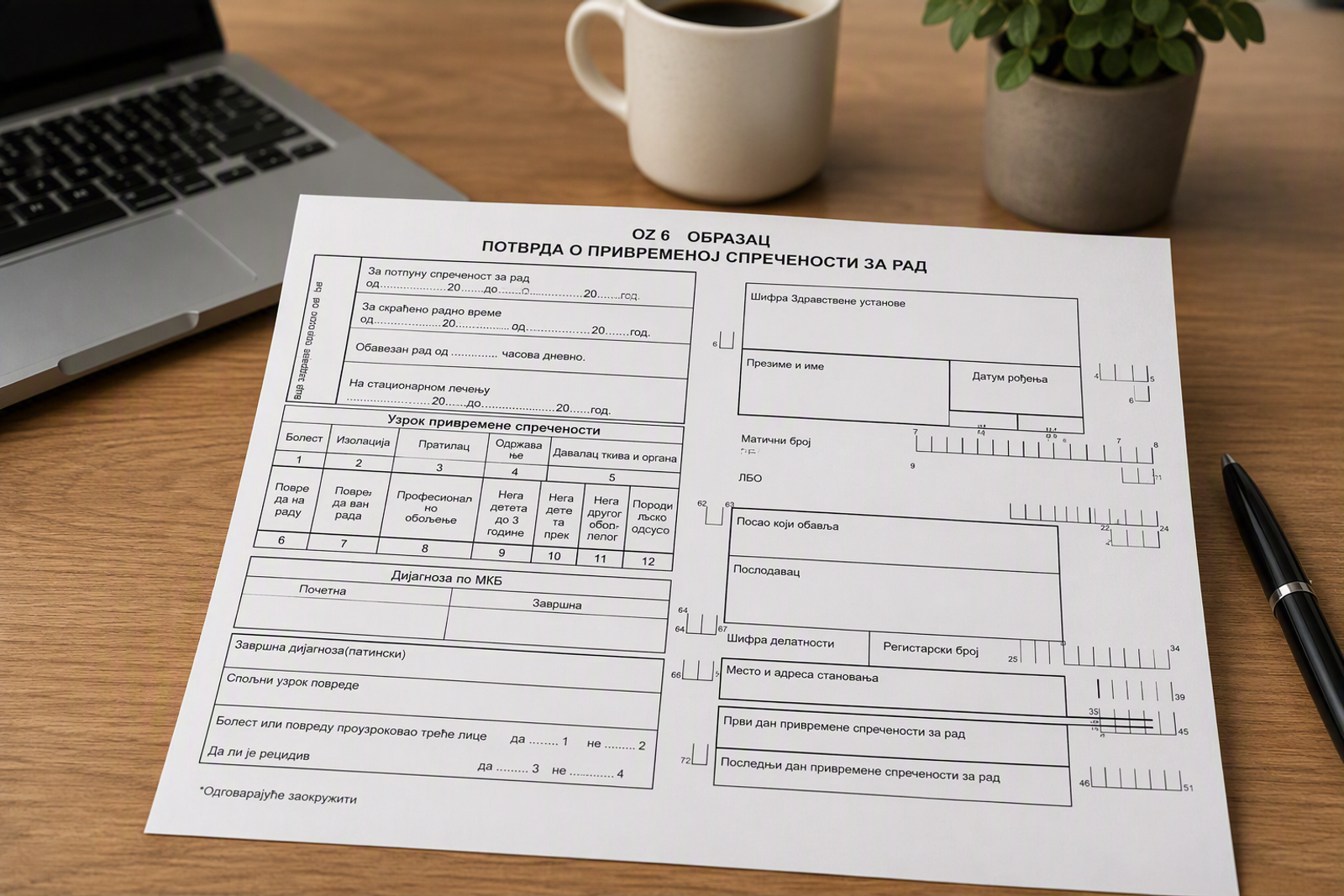
As of 1 January 2026, the „eBolovanje – poslodavac“ (eSick Leave – Employer) system has been introduced in Serbia, representing a significant step forward in the digitalisation of processes relating to employees’ sick leave. The changes have been introduced with the aim of reducing the administrative burden and facilitating communication between the employee, the physician and the employer.
In this article, we set out the most important novelties, obligations and advantages relating to the „eBolovanje – poslodavac“ system.
IN THIS ARTICLE:
- How did it work until now?
- What has changed and how does the new system work?
- What are the advantages of the eSick Leave system?
- What are the employers’ obligations in relation to eSick Leave?
- Recommendations for Employers.
1. How did it work until now?
Sick leave meant a pile of paperwork, administration and visits by the employee to the selected physician and to the employer. The employee had to deliver certificates, the employer had to process them, and the physician had to issue them. In order for the employee to justify the absence from work and exercise the right to salary compensation, a number of steps had to be taken, which in practice also led to significant problems and difficulties:
The employee
- was obliged to deliver to the employer the certificate of temporary incapacity for work issued by the selected physician, within 3 days from the day such incapacity occurred;
- was obliged to deliver to the employer the report on temporary incapacity for work (sick leave certificates — „doznake“) once or several times, depending on the duration of the sick leave — these certificates were also issued and delivered in paper form and required the employee to visit the selected physician once or several times in order to deliver the documentation to the employer.
The employer
- was obliged to process and administer all documentation manually, irrespective of whether the compensation is ultimately paid from the employer’s funds or from health insurance funds, which resulted in a considerable expenditure of time and possible errors;
- often did not have timely information on the reasons for the employee’s absence from work and the duration of such absence, until notified thereof by the employee, which caused numerous problems in practice;
- had at its disposal an administratively complex control of sick leave, which was carried out outside a single (electronic) system.
The selected physician
- was obliged to issue all of the aforementioned documentation in paper form.
Accordingly, such a system of exchange of data, documents and notifications in the event of sick leave entailed the exclusive use of paper documentation, the employee’s obligation to notify the employer and deliver the documentation, as well as a significant expenditure of resources, both of employers and of health care authorities, for administrative purposes.
2. What has changed and how does the new system work?
2.1. The procedure in the event of sick leave
An employee who has health problems visits the selected physician who, after establishing that grounds for sick leave exist, enters all the necessary data into the electronic system, including the expected duration of the sick leave and the date of the follow-up examination — in this way, the certificate of temporary incapacity for work is generated on the electronic portal.
Thereafter, at the follow-up examination, the physician establishes whether the need for sick leave has ceased or whether there is a need for its extension. In the first case, the sick leave is closed, whereas in the second case, data on its continuation are entered into the system.
The relevant data, notifications and documentation (certificate of temporary incapacity for work, sick leave certificates, etc.) will be automatically available to the employer on the eUprava eGovernment portal (module: „Privremena sprečenost za rad“ / Temporary Incapacity for Work).
2.2. Additional functionalities of the system
In addition to the changes in the procedure in the event of an employee’s sick leave, the system also offers additional functionalities which, to a significant extent, consolidate the procedures and contribute to practicality in relation to sick leave:
- Handling of calculations within the system — the employer may electronically file a request for the calculation of salary compensation and/or a request for the refund of salary compensation, as well as monitor the processing of the filed requests and receive the calculation (module: „Lista obračuna naknade zarade“ / List of Salary Compensation Calculations);
- Objections and requests — through the system, the employer may file:
- an objection to the assessment of the selected physician / first-instance medical board;
- a request for a re-assessment;
- a request for an expert evaluation of temporary incapacity for work;
- a request for the issuance of a decision on the calculation for the purpose of initiating an administrative dispute,
as well as monitor the decision-making on the filed requests (module: „Prigovori i zahtevi“ / Objections and Requests).
3. What are the advantages of the eSick Leave system?
The advantages of the system are numerous and are reflected in the connection between employers, the selected physician and the Republic Health Insurance Fund (RFZO), in a faster and more reliable exchange of data between all participants, the abolition of paper documentation, the reduction of the possibility of errors and abuses, easier access to data and documentation, and savings of time.
The employer
The most significant benefits relate to the employer and are reflected in:
- timely notification of an employee’s sick leave and its presumed duration;
- the possibility to receive, review and download certificates of temporary incapacity for work, sick leave certificates and data on the employee’s sick leave, as well as to have insight into the status of the employee’s sick leave;
- the electronic filing of requests for the calculation of salary compensation and requests for the refund of salary compensation;
- the reduction of administration and savings of time for processing data and documentation relating to an employee’s sick leave — all data, notifications and documentation are available electronically, which reduces the expenditure of time and potential errors relating to sick leave and the calculation of salary compensation;
- the reduction of room for abuse of sick leave and the possibility to control sick leave by filing an objection to the assessment of the selected physician / first-instance medical board, a request for a re-assessment and/or a request for an expert evaluation of temporary incapacity for work.
The employee
The most important novelty, and at the same time a benefit for employees, lies in the fact that the employee is not obliged to collect and deliver to the employer either the certificate or the sick leave certificates, given that the documentation will be available to the employer electronically and automatically.
The selected physician
The changes introduced by the „eBolovanje – poslodavac“ system will certainly also represent a benefit for selected physicians, both due to reduced administration and due to better and more practical insight into the sick leave history of the patient (the employee).
4.What are the employers’ obligations in relation to eSick Leave?
Registration of employers (legal entities) and the use of the eSick Leave system are mandatory. In order to benefit from the new system, but also in order to fulfil their statutory obligation, employers were required to register on the eUprava eGovernment portal no later than 1 January 2026, as well as to use the „eBolovanje – poslodavac“ software solution. Employers who are entrepreneurs employing one or more persons are required to register and access the system no later than 1 January 2027.
Registration deadlines
Category of employer
Deadline for registration and access
Employers — legal entities
1 January 2026
Employers — entrepreneurs employing one or more persons
1 January 2027
Fines for non-compliance
The fines for employers’ non-compliance are not insignificant, and therefore registration and the use of the portal should not be postponed.
Subject liable to a fine
Range of the fine
Employer — legal entity
RSD 50,000 – 200,000
Responsible person within the legal entity
RSD 5,000 – 25,000
Entrepreneur employing one or more persons
RSD 10,000 – 50,000
This article is for informational purposes only and does not constitute legal advice. For legal consultation, feel free to contact us.
Stanković & Mijatović